Suzuki Access 125 Through The Years: What Actually Changed Across Three Generations
By 91motorsMay 15, 2026
A rider's honest take on India's most loved 125cc scooter — from 2007 to today.
Let me tell you something funny. Every time I park my Access at the local market, at least one uncle walks up and goes, "Beta, kitna deti hai?" And every single time, I lie a little bit and say "around 50." Because if I say 55, no one believes me. If I say 45, they look disappointed. So 50 it is. That's the Suzuki Access 125 for you. It's the kind of scooter people have opinions about — even the ones who've never sat on it. Your dad has one. Your neighbour swears by it. That cousin who claims he can fix anything mechanical? He's also got one in his garage, half-disassembled, with parts spread on a newspaper. I've been riding scooters for over a decade now, and I've owned two Accesses across two generations. So this isn't some brochure summary — this is what's actually changed across the three generations, and what I think about each of them after enough kilometres to notice. Pull up a chair. This might take a minute.
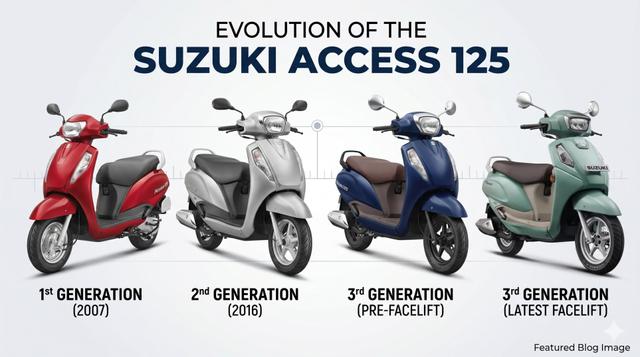
The Original Access 125 (2007) — The One That Started It All
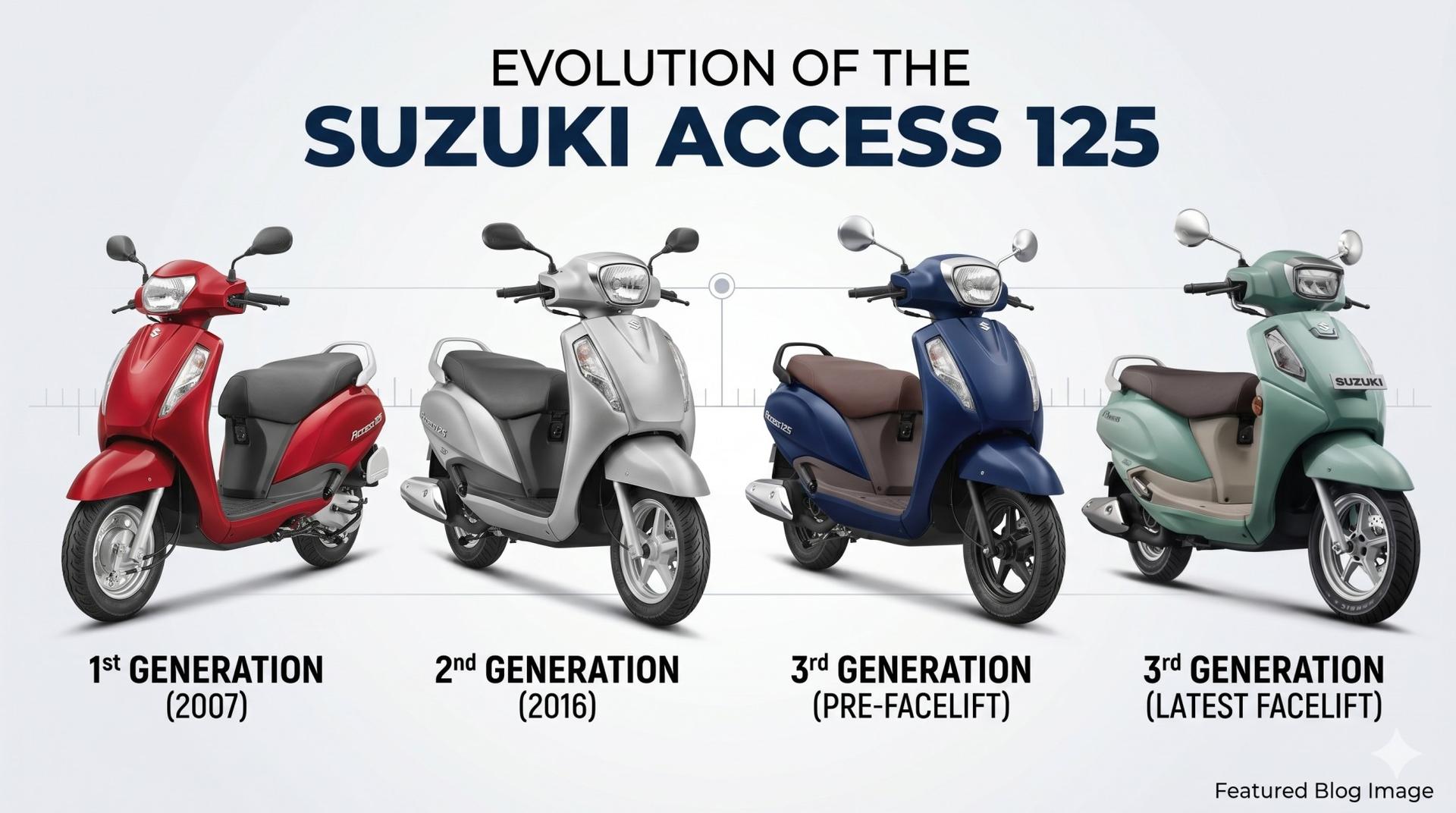
In 2007, scooters in India were, frankly, a bit pathetic. Most of them were 100cc, sounded like a sewing machine on its last legs, and if you put two grown adults on one, the poor thing would basically refuse to climb a flyover. Then Suzuki dropped the Access 125. And it just… changed things. It was India's first 125cc four-stroke scooter. That doesn't sound like a big deal today, but back then? It was like someone finally turned the lights on. Suddenly you had real torque. You could pull two people up a hill without praying. The acceleration didn't feel apologetic anymore. The other thing nobody talks about enough — it was the first scooter in India to get a telescopic front fork. If you've never ridden an old bottom-link suspension scooter over Indian roads, count yourself lucky. Every pothole felt like a punch. The Access fixed that, and once you've ridden something with proper suspension, you can't really go back. The design was, well, grown-up. Not flashy. Not trying too hard. A bit like a dependable family car — you wouldn't call it exciting, but you'd trust it to be there when you needed it. My uncle bought one of these in 2009. That same scooter, I am not kidding you, is still doing the morning milk run in my hometown. Same scooter. Sixteen years later. He's changed the battery twice, replaced the tyres maybe four times, and that's basically it. People keep telling him to upgrade. He keeps not listening. One thing I'd tell any Gen 1 owner: Don't skip oil changes. These older carburetted engines are forgiving, but they punish neglect. Every 2,500–3,000 km, change the oil. And during monsoon, get the carb cleaned at least once. Water finds its way into everything in this country.The Gen 2 Access 125 (2016 onwards) — When Suzuki Hit Refresh
By 2016, the Access was getting old. The Honda Activa 125 had arrived, the segment had grown, and customers wanted more — better mileage, better features, safer braking. Suzuki could've just slapped on a new sticker and called it a day. They didn't. The Gen 2 was a proper redesign. Lighter chassis, sharper styling (though still recognisably an Access), and a new engine with what Suzuki called SEP — Suzuki Eco Performance technology. The headline was fuel efficiency, and it did deliver. A friend of mine who switched from a Gen 1 to a Gen 2 said he was getting almost 8 km/l more on the same commute. That's real money saved over a year. The wheel size went up from 10 inches to 12 inches at the front. Sounds nerdy, but it matters. Bigger wheel means better stability over bad roads, less twitching when you hit ruts, less drama at higher speeds. You feel it on the first ride. They also offered a front disc brake with combined braking system as an option. Honestly, if you're shopping for a used Gen 2, get the disc variant. The drum version is fine for chill riding, but the moment a stray dog jumps out (and one will, eventually), you'll want that disc. Then 2020 happened. BS6 norms came in, and Suzuki added fuel injection. This was when the Access went from "good" to "honestly very good." No more cold-start fuss on December mornings. No more weird hunting at idle. Throttle response cleaned up beautifully. After that they kept adding small things — an LED headlamp, an external fuel filler lid (such a small thing, but if you've ever stood at a petrol pump lifting the seat in the rain, you understand why this is a quality-of-life upgrade), and eventually Suzuki Ride Connect with Bluetooth for navigation alerts and call notifications. A small road trip story — I rode my Gen 2 from Delhi to Alwar last winter. Two of us, plus a duffel bag. Highway speeds of around 75–80 kmph for most of the journey. I didn't expect much from a 125cc scooter on a 180 km ride, but it just… didn't complain. Got back home, did the math — 48 km/l. With a pillion. On the highway. That's almost obnoxious value for money. By 2023, the Access had crossed 5 million units sold in India. By 2024, six million. Whatever Suzuki was doing, it was working.The Gen 3 Access 125 (2024 onwards) — The Modern One
Alright, now to the current generation. The new Access 125. I'll be straight with you — I was sceptical at first. The Gen 2 was already so good, what was there left to improve? Then I sat on the new one and rode it for a week, and I get it now. The 124cc engine has been reworked from inside — new camshaft, redesigned intake and exhaust. On paper, sure, that sounds like brochure noise. On the road, the difference shows up in the mid-range. That 30 to 60 kmph pull, which is basically where you live in Indian city traffic, feels stronger and more willing. The CVT has been retuned too, and the result is a scooter that feels eager rather than just adequate. Mileage is the part Suzuki is proudest of. They claim around 64 km/l. In my actual riding — mixed city use, no babying the throttle — I was getting 55-ish. Which, frankly, is still ridiculous. The tech jump is where Gen 3 really pulls ahead though:- Suzuki Ride Connect is now properly useful — turn-by-turn navigation on your cluster, call and message alerts, even scooter diagnostics on your phone.
- The underseat storage is 24.4 litres. A full-face helmet fits with room to spare. I've fit groceries, a small backpack, and a raincoat in there on the same trip.
- There's a USB charging port, which sounds basic until your phone dies five minutes into a Google Maps route.
- The external fuel filler is still there, thank god.
- And here's the big one — single-channel ABS. The new Access is the bestselling 125cc scooter in India to come with ABS. On a wet Mumbai July evening or a dusty Bangalore back road, this isn't a feature you should have to think twice about.
So, What Actually Changed? The Honest Summary
If you boil down nearly twenty years of evolution, here's how I'd put it:| Bit | Gen 1 (2007) | Gen 2 (2016–2023) | Gen 3 (2024 onwards) |
|---|---|---|---|
| Engine | 124cc carburetted | SEP, then FI in 2020 | Reworked 124cc, retuned CVT |
| Suspension | Telescopic fork (first ever in India) | Telescopic + 12" front wheel | Refined further |
| Tech | None worth mentioning | LED, Bluetooth, external filler | Full Ride Connect + navigation + USB |
| Safety | Drum brakes | Optional disc + CBS | Single-channel ABS |
| Storage | Basic | Improved | 24.4L, fits a full-face |
| Mileage (real-world) | 45–50 km/l | 50–55 km/l | 55–60+ km/l |
Some Genuine Maintenance Advice From Someone Who's Been There
Since we're chatting like friends — here's the stuff nobody tells you, regardless of which generation you own:- Engine oil every 3,000 km. Don't push it to 5,000 thinking modern oils handle it. They don't, not in our heat and traffic. Use a good 10W-30, ideally Suzuki's own.
- Air filter at every service. Indian cities are dusty as hell. A clogged filter quietly murders your mileage and power.
- CVT belt — check it at 18,000–20,000 km. If it snaps mid-ride, you're stuck. Replace it proactively.
- Tyre pressure once a week. Boring advice. Saves fuel, saves your back, saves your tyres.
- For Gen 3 owners, keep the Ride Connect app updated. It actually tells you when something needs attention.
- One more thing — if your scooter starts feeling sluggish but everything seems fine, get the throttle body cleaned (on FI variants) or the carb cleaned (on older ones). Nine times out of ten, that's the culprit.
So Should You Buy The New Suzuki Access 125 In 2026?
Honestly? Look, it's not perfect. The design is conservative. There's no TFT screen. No keyless ignition like some rivals. If you want flash, this isn't it. But here's the thing — and six million owners can't all be wrong — the Access just works. Day after day. Year after year. Across two decades. The new Gen 3 with ABS, navigation, big storage, refined engine, and that classic Access ride comfort? It's probably the most complete family scooter you can buy in India right now. Whether you're a college kid commuting, a working parent doing daily drops, or someone who just wants a no-drama scooter that'll last a decade — the Access has earned its spot. And as far as I'm concerned, it's earned mine too. Right, my chai's stone cold now. But I think you got the gist.Quick FAQs
- What is the mileage of the new Suzuki Access 125 (Gen 3)? Suzuki claims around 64 km/l. In actual city riding, expect 55 km/l comfortably. Highway with a pillion, around 48–50.
- Does the new Suzuki Access 125 have ABS? Yes, single-channel ABS. It's currently the bestselling 125cc scooter in India to offer it.
- Is the Suzuki Access 125 good for tall riders? Pretty good, actually. The seat is roomy, the floorboard is spacious, and even riders over 6 feet can be comfortable on long rides.
- What's the price of the new Suzuki Access 125? Roughly ₹78,984 to ₹99,278 ex-showroom depending on variant.
- Access 125 or Honda Activa 125 — which one? Both are solid. Access edges ahead on mileage, storage, and the ABS bit. Activa wins on dealer network reach in some smaller towns. Test ride both. The seating feel is different, and you'll know within five minutes which one suits you.